- Blog
- European Used Car Market Mid-Year Report 2026: Trends, Prices & Demand Analysis
European Used Car Market Mid-Year Report 2026: Trends, Prices & Demand Analysis
Explore what 2026 EU automotive market data shows about used car demand, EVs, hybrids, LCVs, and prices. See what dealers should watch in Q3 and Q4.

Whether you’re planning to expand your dealership, introduce new fuel types, or even maintain your current approach, you have to know what's going on in the used car market.
Regardless of your goals, current data and trends help you make more informed decisions.
That’s why we’ll look at the data available for the first half of 2026 and see what it tells us about the market so far.
Automotive market in the EU so far - June 2026
The first half of 2026 has brought us mixed results.
On the positive side, new-car registrations are growing again. However, the used-car market isn’t following that upward trend in many places.
More precisely, only some used-car markets, like Spain and Italy, showed significant positive results.
There have also been changes in preferred fuel types.
According to ICCT, EVs reached a 20% market share in Europe in Q1 2026 and 21% in March alone.
But results still vary a lot depending on the market and vehicle type.
As you can see, the general data is useful, but it’s not always enough to guide business decisions.
To get a clearer view, let’s look at specific segments one by one.
Are car registrations growing?
Overall, new-car registrations are growing in the EU.
But the picture isn’t so consistent when we consider used cars.
According to ACEA, EU new-car registrations increased by 4.2% between January and April 2026.
From that, we can see that demand has improved compared to the same period in 2025.
So, that’s a positive sign for the overall automotive market.
Electrified vehicles accounted for a large part of this growth.
Hybrid-electric vehicles remained the leading fuel type, while full EVs increased their market share and plug-in hybrids also continued to grow.
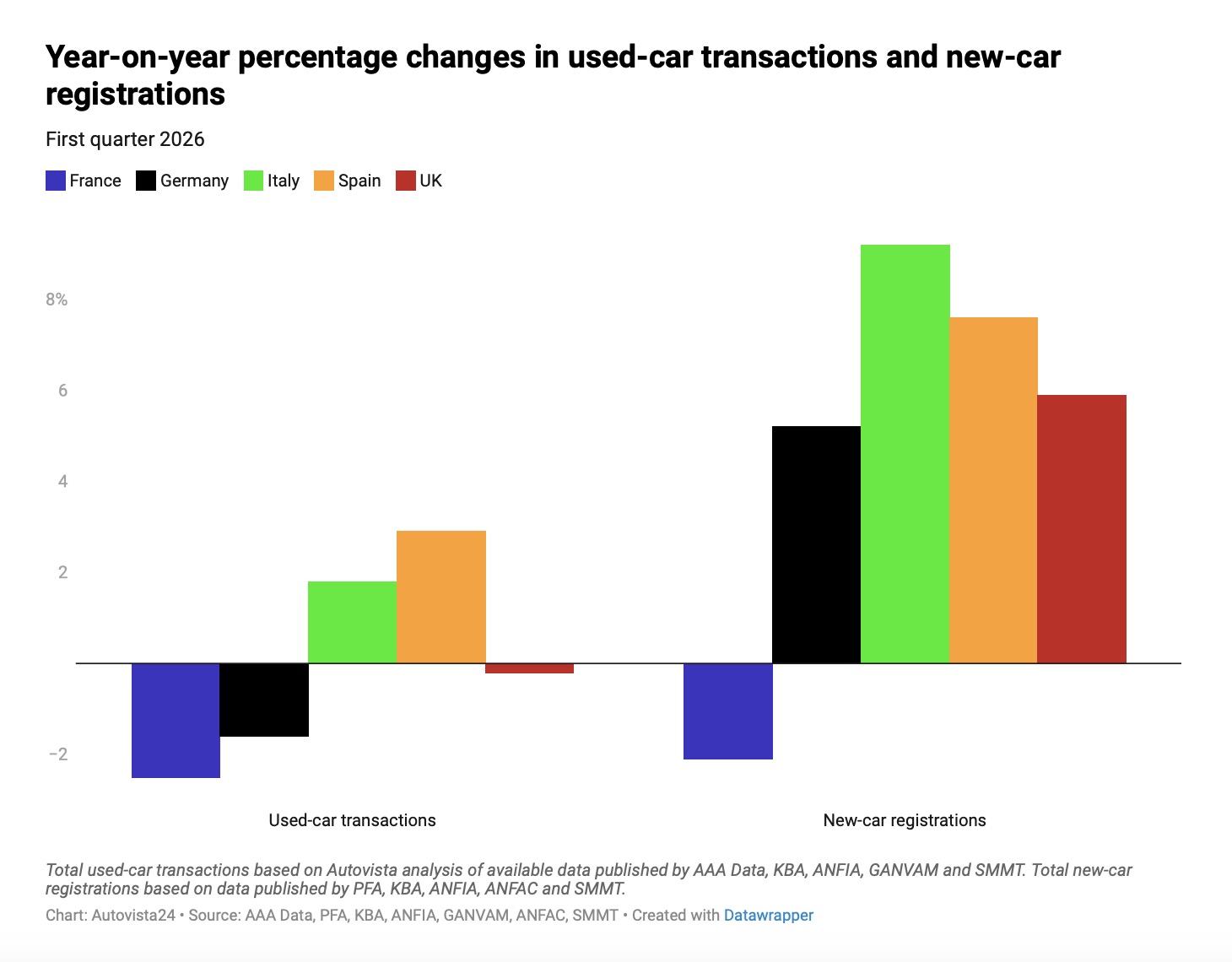
However, Autovista24’s analysis of Europe’s largest used-car markets shows that total used-car transactions varied from country to country in Q1 2026, which you can see below.
Source: Autovista24
The graphs above tell us that:
- France saw used-car transactions decline compared to the year before.
- Germany also had a decline in used-car transactions.
- Italy saw used-car transactions increase.
- Spain had the strongest growth among these markets.
At the same time, new-car registrations were positive in Germany, Italy, and Spain, but negative in France.
So, the short answer is: new-car registrations are growing in the EU, but the used-car market is more uneven.
And since stronger new-car registrations don’t always mean higher demand for used cars, it’s important to follow trends in your local market.
Slow recovery for vans and LCVs
It’s always worth checking how LCVs perform separately because they don’t always follow the same trends as passenger cars.
In 2026, the LCV market is showing signs of recovery, but the pace is still slow.
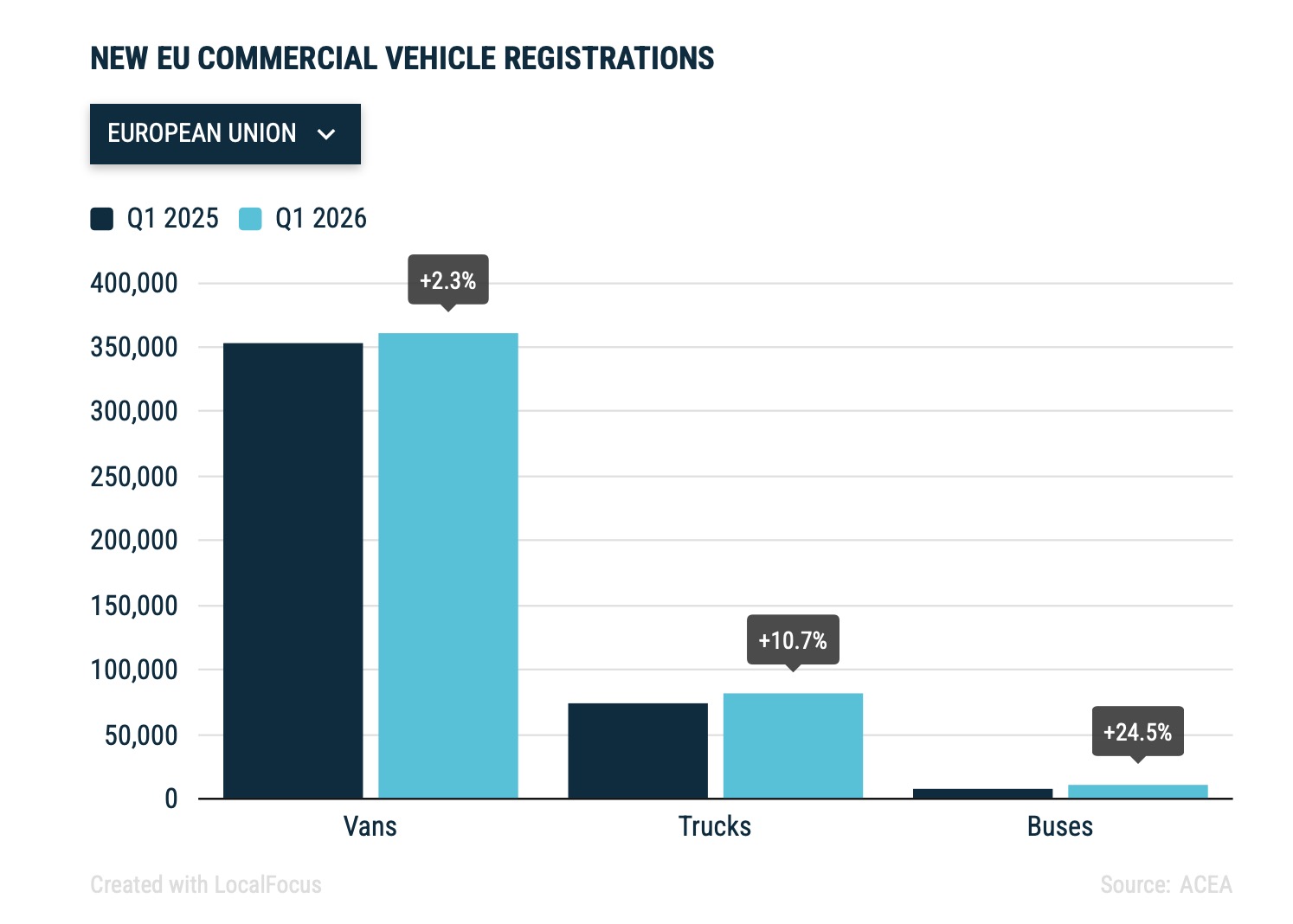
ACEA data for Q1 2026 shows that new EU van registrations increased by 2.3% compared with the same period in 2025.
This is a positive result, but the recovery is still slow, especially compared with buses and trucks.
Source: ACEA
The recovery is also uneven across major EU markets.
Spain had the strongest van growth among the large markets, while France also increased. Germany and Italy, however, saw declines.
What could this info mean for dealers offering LCVs?
Well, van demand is still supported by practical business needs.
Many buyers need vans for work, deliveries, trades, or logistics, so the used LCV market can be active even when new registrations aren’t growing quickly.
Another thing to keep in mind when looking at LCV data is that the transition to electric vans is slower than that for passenger cars.
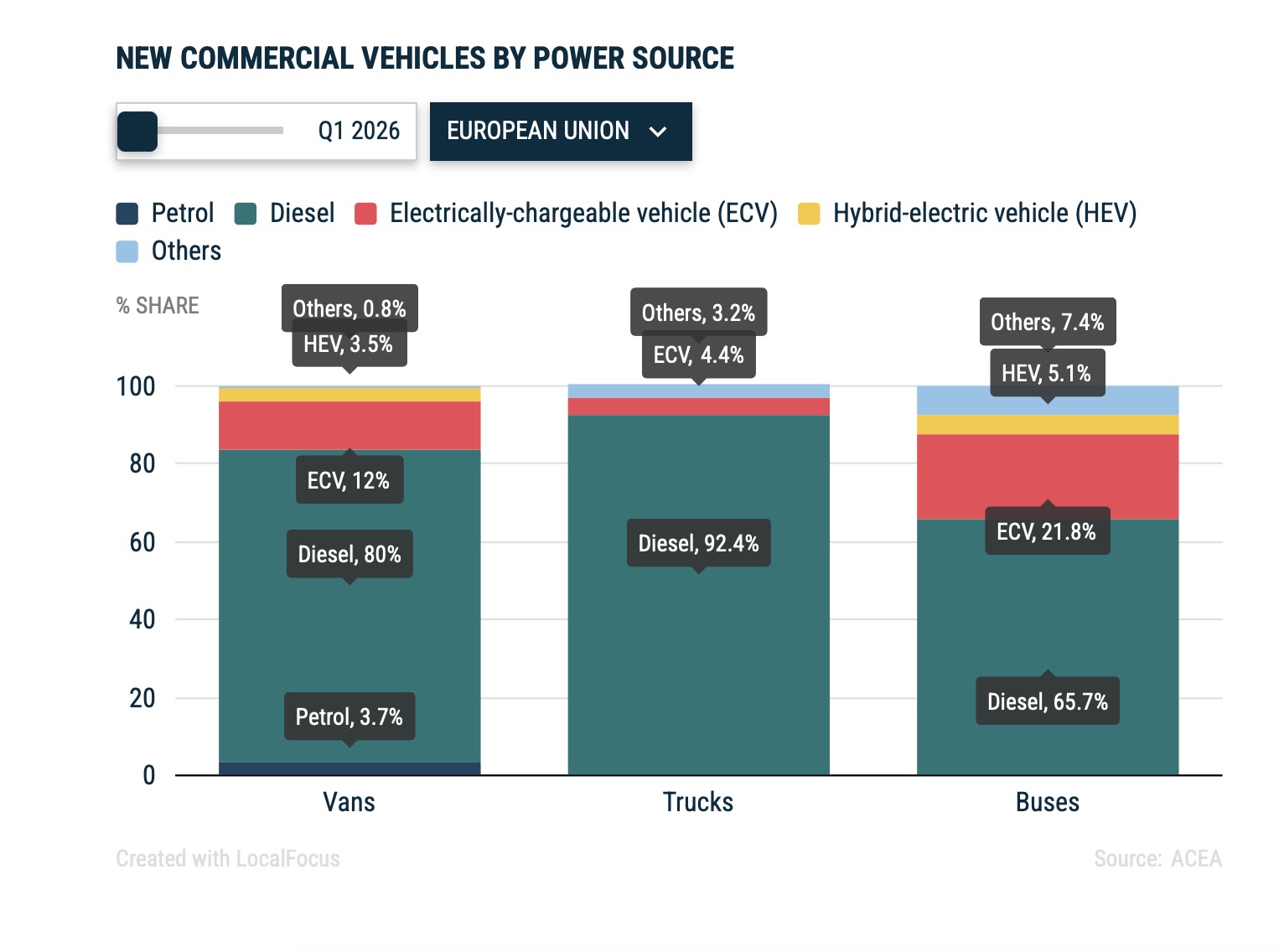
Diesel is still the top choice for vans in the EU.
Electric vans are growing, but they still make up a much smaller part of the market, as seen in ACEA’s overview of new LCV power sources.
Source: ACEA
So, if your dealership offers used LCVs, remember that diesel commercial vehicles remain important to many buyers.
But if you’re selling to business buyers in urban areas with low-emission zones, you definitely shouldn’t ignore electric vans.
Hybrids vs EVs - demand in 2026 vs 2025
Now, let’s see how electrification is going.
Last year, in our 2025 market analysis, we saw that PHEVs and HEVs accounted for 43,9% of the new car registrations in the EU. Full EVs had a 16.9% market share.
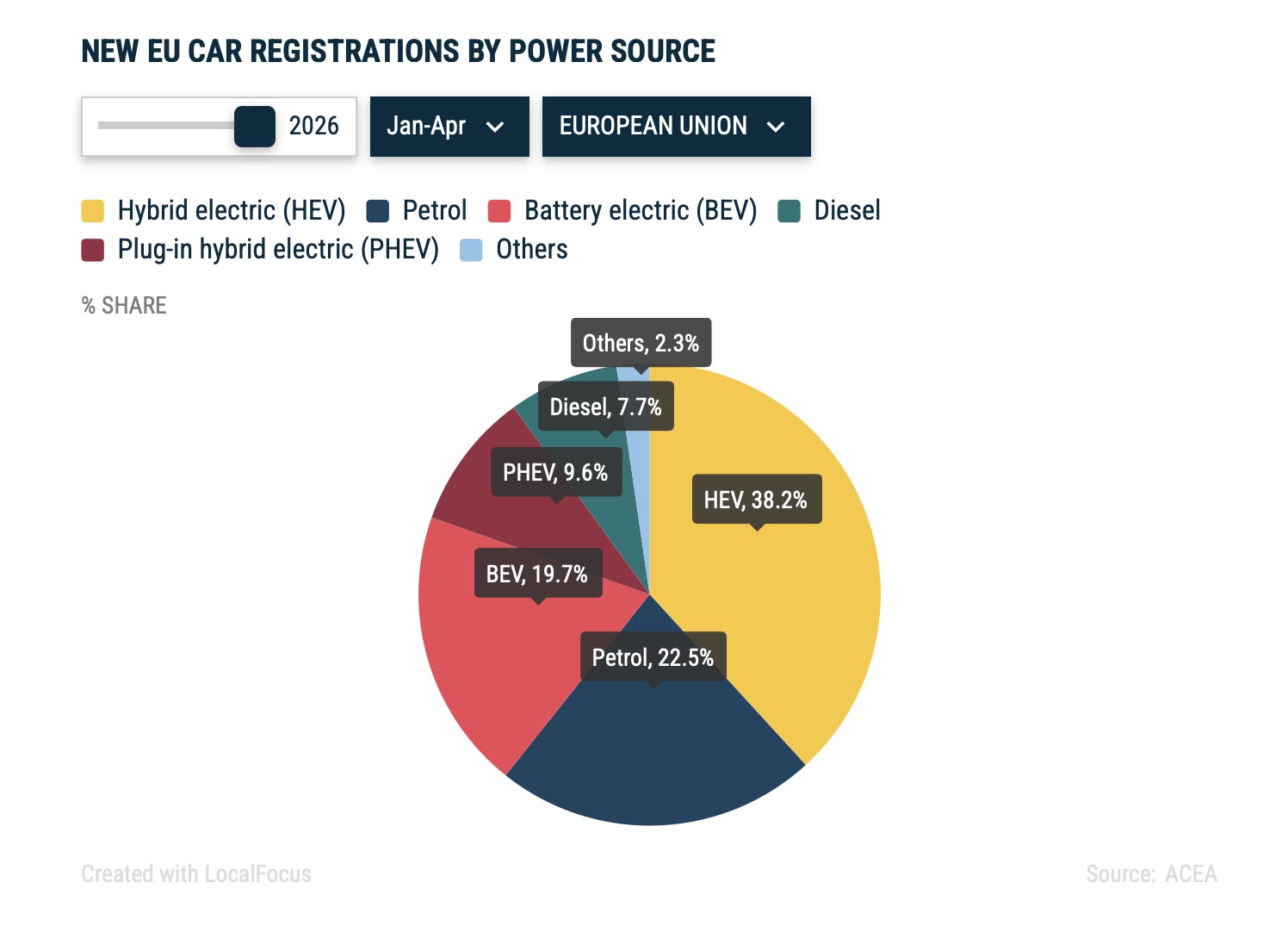
Based on ACEA’s data available for the first half of 2026, demand for new hybrids and EVs has grown even more.
Source: ACEA
HEVs and PHEVs now account for almost half of the EU market (47.8%). Full EVs account for another 19.7%.
These figures from the new-car market suggest that while buyers are ready to embrace electrified vehicles, many still prefer hybrids to fully electric cars.
The used-car market shows a similar pattern, but the change is happening more slowly.
According to Autovista24, used EV sales are growing in some EU markets, but they still account for a small share of overall used-car sales.
Spain is a good example here: used BEV sales grew strongly in Q1 2026, but EVs still made up only 4.2% of all used-car transactions.
So, although more buyers are becoming interested in used EVs, hybrids can still feel like the easier, more familiar choice for many.
Are used cars getting cheaper?
One of the most important questions for used-car dealers is price.
The answer is not that simple.
Used cars are not getting cheaper everywhere or in the same way.
What we can say is that residual values are getting weaker.
In simple terms, residual value shows how much of its original new-car price a vehicle still keeps after some time on the market.
According to Autovista24, used cars in major European markets are losing a greater share of their original value.
Still, that doesn’t always mean that a used car’s price is lower in euros.
Autovista24 also points out that new-car list prices are still rising in many cases.
So, even if a used car keeps a smaller percentage of its original value, its actual price can still remain stable depending on the market.
Because of all of this, you can expect buyers to be careful about their budgets.
You should be especially careful about used EVs. Autovista’s data show that it took longer to sell used EVs than ICE cars.
That means there is interest, but buyers are selective.
Used EVs can still sell well, but you’ll have to choose the right ones for your local market.
eCarsTrade analysis: Is demand for used electric vehicles growing across the EU?
Demand for used EVs is growing across the EU, based on external data from Autovista24.
We see the same trend on eCarsTrade, where used EV sales have been increasing year over year across different European markets.
Traders have been showing greater interest in electric models because they help meet growing buyer demand.
However, traders are not looking for any EV at any price.
The strongest demand is for EVs that are easier to resell, especially those with:
- Recognisable brands
- Good real-world range
- Clear battery and service history
- Competitive pricing
So, before adding an EV to stock, check if the model has enough demand in your market, how quickly similar EVs are selling, and whether you can offer it at a price buyers will accept.
What is impacting the European automotive market in 2026?
Buyer demand isn’t the only thing shaping the car market.
Let’s look at other important factors that affect what cars are available and how they are priced.
► Changes to CO₂ emissions rules
CO₂ emissions rules are among the most important factors shaping the car market.
Although the 2035 ICE ban is still being debated and may not be final, the general direction is clear: the EU is moving toward lower-emission transport.
For manufacturers, this means they still have a reason to sell more EVs and hybrids.
But since the 2035 target isn't fully settled, petrol and diesel cars still matter, especially in the used-car market.
► More EV supply from Chinese brands?
Emerging EV brands, especially Chinese brands, are also influential.
There’s now a wider choice of EV brands, meaning that buyers can be selective.
This also affects pricing, as established manufacturers must compete with newer brands that offer EVs at different price points.
► Manufacturers are reducing production
Production in factories is another thing to consider.
Several manufacturers are adjusting production or reducing costs.
Volkswagen is one example, having reduced the number of employees in Germany.
Stellantis is also planning to stop vehicle production at its Poissy factory near Paris by 2028.
This is significant because production changes today can affect the used-car supply later.
If fewer new cars are built or registered now, there may be fewer young used cars available in two or three years.
► EV and hybrid incentives are changing
Government incentives can change what types of cars buyers consider.
Across Europe, support for EVs and hybrids is moving in different directions.
Some countries are introducing or extending EV incentives, while others are reducing tax benefits or treating hybrids less favorably.
For example, Germany introduced a new EV incentive program for lower- and middle-income private buyers, while Spain is replacing MOVES III with Plan Auto +.
Changes like these can affect demand for new EVs and hybrids, and later influence what enters the used-car market.
What changes should your dealership make in Q3 and Q4?
In the second half of 2026, you should thoughtfully approach what you add to stock.
Rather than relying on broad European trends, check what is happening in your own market first.
You should pay attention to:
- Local demand
- Local rules
- Incentives
- Low-emission zones
- Which fuel types buyers are actually choosing
This is especially important for EVs, hybrids, and LCVs because demand can vary widely from one country or city to another.
Start sourcing wholesale vehicles with eCarsTrade
Once you identify which cars are in demand, the next step is to stock up your dealership.
You can do this efficiently by sourcing wholesale vehicles through a platform built for professional car traders, such as eCarsTrade.
Our platform gives you access to a wide range of used cars from across Europe.
On eCarsTrade, you can compare different models, fuel types, mileage, prices and vehicle conditions in one place.
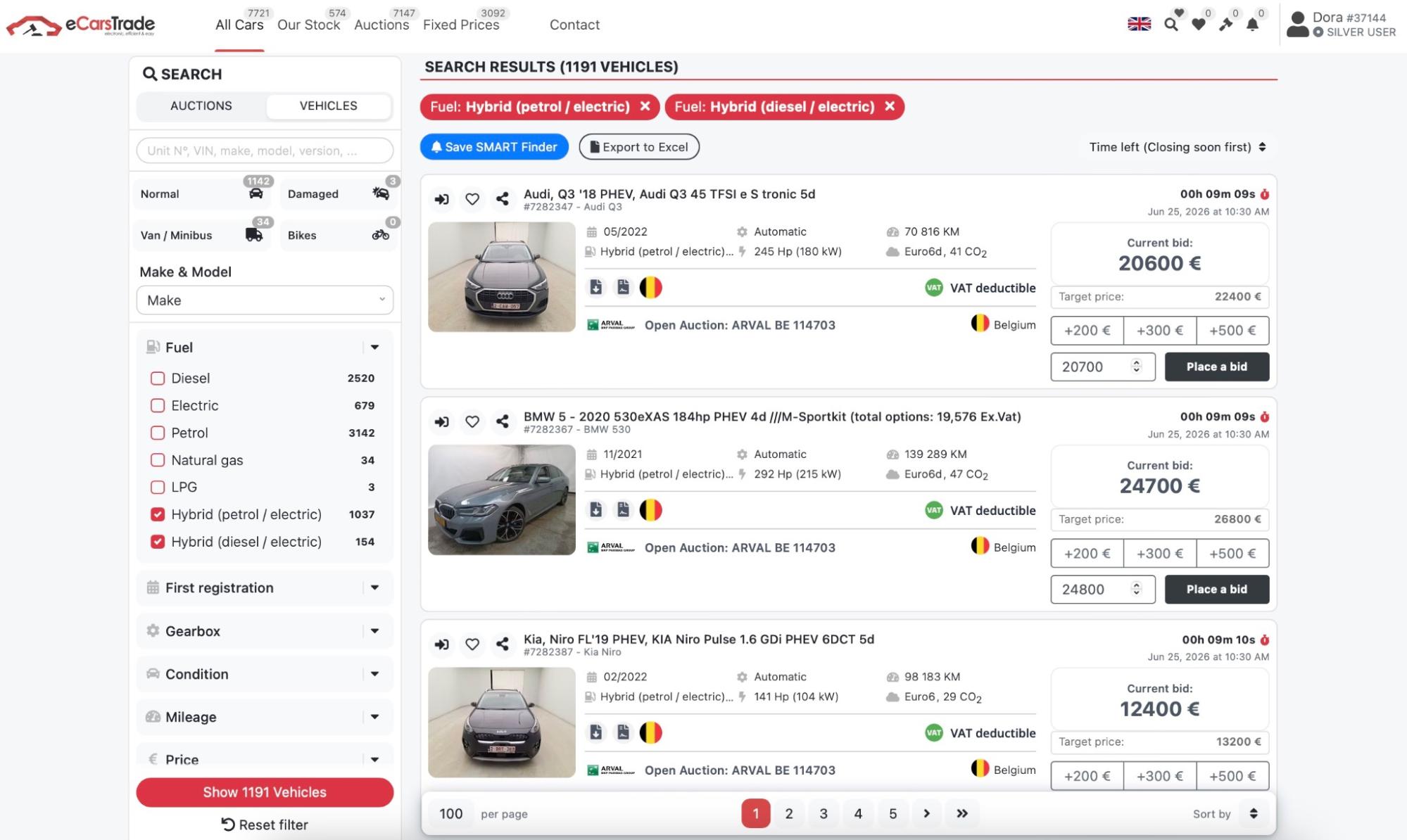
Filters will help you quickly find the cars that match your market demand, whether you’re looking for hybrids, EVs, LCVs, petrol cars or diesel vehicles.
You’ll also see the key details and available documents before you bid.
This helps you compare options and find the best vehicles for your dealership’s needs.
Sources used in the article:
- ICCT. (2026). European Car Market Monitor: March 2026
- ACEA. (27 May 2026). New car registrations: +4.2% in April 2026 year-to-date; battery-electric 19.7% market share
- Autovista24. (18 May 2026). Surprising start to 2026 for Europe’s largest used-car markets
- ACEA. (29 April 2026). New commercial vehicle registrations: vans +2.3%, trucks +10.7%, buses +24.5% in Q1 2026
- ACEA. (20 May 2026). Vans: Europe’s decarbonisation blind spot
- Autovista24. (1 June 2026). Monthly Market Update: New-car list prices and residual value impacts
- Automotive World. (2026). Blume: Volkswagen to cut 19,000 jobs by end of 2026
- Electrive. (16 April 2026). Stellantis to end production at Poissy plant by 2028
_01JE9WH8CRTMG3B3WDH56WNJHD.png)